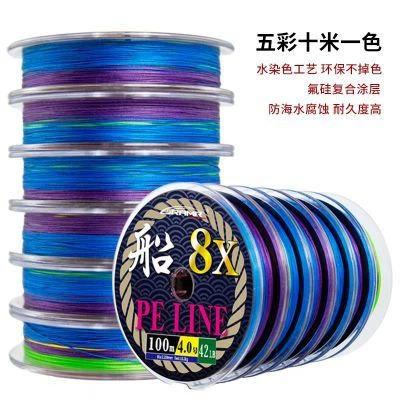
GUANMEI Fishing Gear Co., Ltd., established in 2000, specializes in the research, development, production, and sales of fishing lines and tackle. We produce high-quality PE braided lines, monofilament lines, fluorocarbon lines, and more, with a daily capacity of 800,000 meters and 30,000 packaged items.
-
![80 Lb Monofilament Fishing Line]() 80 Lb Monofilament Fishing LineGRAMR Strong 50lb 60lb 80lb Monofilament Fishing Line is built to take on giant fish like black carp, silver carp, bighead carp, and sturgeon.
80 Lb Monofilament Fishing LineGRAMR Strong 50lb 60lb 80lb Monofilament Fishing Line is built to take on giant fish like black carp, silver carp, bighead carp, and sturgeon. -
![30 Lb Monofilament Fishing Line]() 30 Lb Monofilament Fishing LineThis GRAMR Smooth Monofilament fishline, engineered for anglers who expect the best. it's made from premium Japanese-imported nylon silk and coated with fluorocarbon, this line offers superior wear
30 Lb Monofilament Fishing LineThis GRAMR Smooth Monofilament fishline, engineered for anglers who expect the best. it's made from premium Japanese-imported nylon silk and coated with fluorocarbon, this line offers superior wear -
![Mono Fishing Line]() Mono Fishing LineColor: Green(support customize). Meters: 150m(support customize). Shape: Monofilament. Material: Japanese nylon silk. Line Number: 0.6#、0.8#、1.0#、1.2#、1.5#、2.0#、2.5#、3.0#、3.5#、4.0#、4.5#、5.0#、6.0#
Mono Fishing LineColor: Green(support customize). Meters: 150m(support customize). Shape: Monofilament. Material: Japanese nylon silk. Line Number: 0.6#、0.8#、1.0#、1.2#、1.5#、2.0#、2.5#、3.0#、3.5#、4.0#、4.5#、5.0#、6.0# -
![12 Lb Monofilament Fishing Line]() 12 Lb Monofilament Fishing LineColor: Light Yellow/Transparent(support customize). Meters: 50m (support customize). Shape: Monofilament. Material: Nylon. Line Number: 0.4#、0.5#、0.6#、0.7#、0.8#、1.0#、1.2#、1.5#、2.0#、2.5#、3.0#、3.5#
12 Lb Monofilament Fishing LineColor: Light Yellow/Transparent(support customize). Meters: 50m (support customize). Shape: Monofilament. Material: Nylon. Line Number: 0.4#、0.5#、0.6#、0.7#、0.8#、1.0#、1.2#、1.5#、2.0#、2.5#、3.0#、3.5# -
![10 Lb Monofilament Diameter]() 10 Lb Monofilament DiameterColor: Red/Transparent(support customize). Meters: 50m (support customize). Shape: Monofilament. Material: Nylon. Line Number: 0.4#、0.6#、0.8#、1.0#、1.2#、1.5#、2.0#、2.5#、3.0#、3.5#
10 Lb Monofilament DiameterColor: Red/Transparent(support customize). Meters: 50m (support customize). Shape: Monofilament. Material: Nylon. Line Number: 0.4#、0.6#、0.8#、1.0#、1.2#、1.5#、2.0#、2.5#、3.0#、3.5#


Quality Control
Using advanced techniques and premium materials, we ensure our fishing lines deliver superior strength, durability, and reliability for fishing enthusiasts worldwide.
Accept ODM/OEM
With over 20 years of OEM and ODM experience, our products are trusted in 100+ countries.
One Stop Service
Meanwhile we can provide comprehensive one-stop services and support customization to help you create your own fishing gear brand. Let us bring your fishing vision to life with quality and expertise you can trust!
High tensile and knot strength: Stronger than fluorocarbon lines per diameter, and better knot strength, max. 95% to preserve.
High abrasion resistance and durability: Due to its high tenacity fibers, the nylon monofilament line is durable and has a higher impact resistance.
Stretchy and high elongation: Usually at 20-25%, which makes them more shockproof and easy-to-knot. But with increased stretchability comes the risk of snapping and a weaker tensile strength.
Line memory: It´s common for nylon monofilament, which is esp. a typical issue for fishing. when wrapped around the spool and stayed in that position long unused, the lines will become as the spirals. The best monofilament, because of advanced manufacturing or materials, has minimal memory.
Moisture absorption: This makes nylon monofilament "looser" and "softer," stretches more. Mono will absorb up to around 4% of its weight in moisture from the atmosphere, and this increases to around 10% if stored in water. Premium-quality monofilament absorbs less moisture.

|
TEST/STRENGTH |
SIZE (mm) |
|
1 lb. |
0.06mm |
|
2 lb. |
0.08mm |
|
3 lb. |
0.10mm |
|
4 lb. |
0.13mm |
|
6 lb. |
0.15mm |
|
8 lb. |
0.27mm |
|
10 lb. |
0.30mm |
|
12 lb. |
0.35mm |
|
15 lb. |
0.40mm |
|
20 lb. |
0.45mm |
|
25 lb. |
0.50mm |
|
30 lb. |
0.55mm |
|
40 lb. |
0.60mm |
|
50 lb. |
0.70mm |
|
60 lb. |
0.80mm |
|
80 lb. |
0.90mm |
|
100 lb. |
1.00mm |
|
130 lb. |
1.20mm |
|
150 lb. |
1.30mm |
|
200 lb. |
1.5mm |
|
250 lb. |
1.80mm |
|
300 lb. |
1.90mm |
Uses of Monofilament Fishing Line
Because monofilament line is so cheap, it is a popular choice for backing. Anglers who like the advantages that fluorocarbon provides but want to save some money can use monofilament as their backing and then use fluorocarbon further down the line.
If you're fishing in low-visibility areas or turbulent water, monofilament comes in many different colors and is easier to see than fluorocarbon lines are.
Because monofilament line suspends in the water, it is great for presenting topwater bait.
Monofilament makes a great “shock leader” for stiffer line, and can help prevent that line from breaking during a hard fight.
Monofilament fishing line (shortened to just mono) is fishing line made from a single fiber of plastic material, as opposed to multifilament or braided fishing lines constructed from multiple strands of fibers. Most fishing lines are now nylon monofilament because they are cheap to manufacture and can be produced in a range of diameters which have different tensile strengths (called "tests" after the process of tensile testing, or possibly as a portmanteau of "tensile" and "strength"). Monofilament line is also available in different colors, such as clear, white, green, blue, red, and fluorescent.
Monofilament is made by melting and mixing polymers and then extruding the mixture through tiny holes, forming strands of line, which is then spun into spools of various thicknesses. The extrusion process controls not only the thickness of the line but its test as well.
Precautions for use of Monofilament Fishing Line
Regularly Check for Line Damage:
Before each fishing trip, inspect your monofilament fishing line for any signs of wear, fraying, or weak spots. Replace damaged sections promptly to prevent potential line failures during crucial moments.
Choose the Right Pound Test:
Select the appropriate pound test that matches your target fish species and the fishing conditions you expect. Adjust the pound test based on the fish's weight and the type of water you'll be fishing in.
Wet the Line Before Knot-Tying:
Prior to tightening your knots, wet the monofilament line to reduce friction and ensure the knots hold firmly. This simple step helps prevent knot slippage and strengthens the overall integrity of the knots.
FAQ
We're well-known as one of the leading monofilament fishing line manufacturers and suppliers in China. If you're going to buy bulk high quality monofilament fishing line at competitive price, welcome to get more information from our factory.
Popular Products