Nylon lines
Also known as traditional lines and four-color lines.
The manufacturing process of nylon lines is generally to take resin and process it into silk (traditional lines) and add other materials such as colors (four-color lines) to the finished products. Its characteristics are better ductility and elasticity.
There are two basic specifications of nylon fishing lines:
One is the specification specified by "pounds" in European and American countries. For example, a ten-pound line can withstand a maximum tension of ten pounds.
The other is fishing lines made in Japan, which are usually distinguished by "number" specifications, and there are also European ones.
The principle is the same as the idea of poundage. For a line of about one number, its maximum tension can withstand a weight of one kilogram, which is a standard basis for pulling fish in the water.
Carbon plastic line
Carbon plastic line: Carbon is added during the manufacturing process to make it more wear-resistant, but its ductility is poor. Because its specific gravity is greater than the general specific gravity of water, it has better water-cutting performance and is suitable for rock fishing (wear-resistant). Its heavier specific gravity makes it accepted by pond fishing. It is also harder and is used for long sub-lines or tied-up hooks (inverted hanging) for boat fishing.
Steel wire
Steel wire: Generally made of multiple strands, single strands are harder and easy to break when damaged, while multiple strands are softer and suitable for general fishing of large objects to prevent biting sub-lines.
Braided line
Braided line: (wiring, fire line, fusion line) Wiring: It is made of multiple strands and has better tensile strength. However, the initial wiring is not coated, easy to absorb water, and difficult to maintain. However, its wear resistance and high tensile strength are better, and it is widely accepted by boat anglers, but its water-cutting performance is poor.
Fire line: It is a multi-strand braided line. During the manufacturing process, a coating is added to each strand of thin wire to prevent water absorption and has good water-cutting properties. However, the damaged part is prone to form a hairball, which is easier to break and has a harder texture. Fusion line: A coating is added to the braided wiring, and multi-strand nylon wire is added during the drawing process. The purpose is to obtain the high tensile strength and wear resistance of the wiring. Due to the addition of nylon wire, this line is softer than ordinary wiring and has better recovery.
Synthetic line
(sinking line, floating line, middle-through rod line) During the manufacturing process of nylon line, other materials are added to the finished product, such as floating materials (floating line), suitable for rock fishing, sinking materials (sinking line) suitable for pond fishing, oily materials (middle-through rod line) and resin processing to add tensile materials (casting line) etc. Tests of the line: 1. Fire, test its carbon content 2. Straighten and rub, test its wear resistance 3. Recovery inertia 4. Knot strength (damage resistance)
Ceramic line
Ceramic line: It is a kind of high-strength fishing line, and is a newly developed fishing line by Japan (Sanglaiyin) Co., Ltd. It is called the sun line by many fishing enthusiasts in my country. It mainly uses high-molecular polymer materials, and fills the gaps between the molecules of the main material with special resins during the line body molding to improve the tensile strength of the line and resist the infiltration of water into the line body. Then, a second layer of special resin is added to the line body to enhance the wear resistance of the fishing line; finally, a third layer of special resin is added to further improve the water resistance of the line. Because the line has excellent tensile strength, wear resistance, and a very low knot damage rate, especially the ability to prevent the infiltration of water into the line after the fishing line enters the water, which is not available in general fishing lines, it will not or rarely increase the weight of the line body and improve the sensitivity of fishing information feedback, so people call it "ceramic line".
Competitive line
Competitive line: Fishing line designed specifically for competition, including many types of fishing lines.
Leisure line
Leisure line: Non-professional line designed for people who are not picky about the line, with many types and low prices, suitable for leisure fishermen.
Gravity line
Gravity line: An innovative and refined work based on the concept of universal gravitation. It is named because of its high specific gravity, fast water cutting, and the instantaneous feeling of entering the water like gravity. Gravity line is made of carefully selected polymer materials. In the first melt spinning of the line body, special resin is filled in the gaps between the molecules of the main material to increase the specific gravity and tensile strength of the line; then in the process of drawing and forming, the second special resin is filled in the gaps between the molecules of the line body material to enhance the wear resistance of the line; after forming, the third layer of special UV resin is treated on the surface to further improve the water-drawing property of the line. After multiple layers of complicated processes, the gravity line has excellent water-resistance, tensile strength and wear resistance. The protection of the outer layer of UV resin, the water-drawing performance repels water, does not increase the load weight of the line body, and can continuously ensure the sensitive feedback of fish information. High-tech fishing line. Polyethylene fishing line
Polyethylene high-performance fishing line: Polyethylene high-performance fishing line is better. The line body of the fishing line includes a core and a coating layer covering the core. The core is composed of a mixture of low-melting-point polyethylene, silicone resin and intermediate medium propyl hydrogen-n-hexane combined with a plurality of strands of polyethylene monofilaments formed by weaving. The coating layer is composed of the above mixture. The polyethylene high-performance fishing line of the utility model is a mixture of molten low-melting-point polyethylene mixed with silicone resin and intermediate medium propyl hydrogen-n-hexane combined with a bundle of polyethylene multifilaments, so that the mixture can be uniformly and stably present between each polyethylene multifilament of the core line, and the outer periphery is covered with the coating layer of the mixture, which can ensure that the fishing line has high strength, more stable toughness and higher wear resistance.
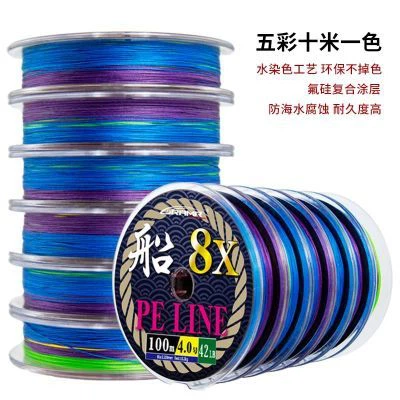
PE fiber type
Use super-strong PE fiber as raw material, and then use the line body reinforcement process to make a super smooth and sensitive rope. Lubricating factors are added to the surface of the line to improve the coating on the surface of the fishing line. The smooth coating makes the fishing line durable, long-lasting in color, and prevents wear and fading. Its performance is better than monofilament fishing line in any case and stands out among other super fishing lines. It has: incredible strength to diameter ratio, reduced tangling, rebound and entanglement between the wire and the rod tip, easier knotting, better knot retention, almost zero stretchability, no reel memory, easy to pass through the wire, throw farther, good wear resistance against equipment and natural risks, and will not cut the wire , long-lasting performance, thin line diameter, high strength: diameter 3.0mm, force 1200 pounds, that is, 550kg, small expansion rate, good recovery performance: breaking expansion rate 7.8-8.8%, five times of force 100kg recovery rate after 99.6%, after shaping, good elasticity, smooth surface, no water absorption: imported glue is used through multiple processes to form a dense protective layer on the surface of the line, and it is difficult for water molecules to penetrate; its shaping performance also prevents the line from swelling due to the infiltration of water molecules, and uses the best fiber in the world as raw material: light specific gravity, floats on the water, is not afraid of strong acid and alkali, and has rich colors: the extremely difficult to color fiber is made through nanotechnology and fine technology to produce colorful colored lines, which are widely used in fishing lines, kite lines, water skiing traction ropes, etc.