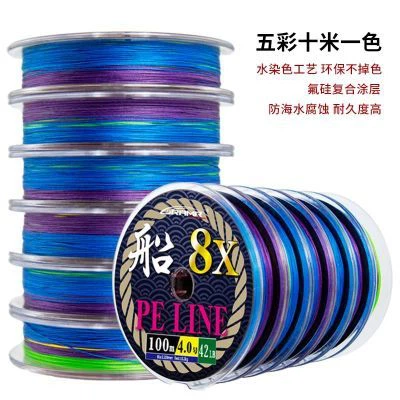
The thickness of fishing line is usually indicated by the line number. The larger the line number, the thicker the line, and vice versa. Common fishing line models include 0.4, 0.6, 0.8, 1, 1.2, 1.5, 2, 2.5, 3, 3.5, 4 and 5. The diameter and tension values of these line numbers are different. For example, the line diameter of 0.4 is 0.104 mm, and the tension range is between 0.88 and 1.33 kg; while the line diameter of 5 is 0.370 mm, and the tension range is between 9.9 and 13.3 kg.
The material of the fishing line will also affect its thickness and performance. Common fishing line materials include nylon line and Dyneema line. The line numbers and diameters of nylon lines are as follows: 0.4 (0.104 mm), 0.6 (0.128 mm), 0.8 (0.148 mm), 1 (0.165 mm), 1.2 (0.185 mm), 1.5 (0.205 mm), 2 (0.235 mm), 2.5 (0.260 mm), 3 (0.285 mm), 3.5 (0.310 mm), 4 (0.330 mm), 5 (0.370 mm). The line numbers and diameters of Dyneema lines are different. For example, the line diameter of 0.4 is 0.104 mm and the tension is 3.08 kg; while the line diameter of 6 is 0.403 mm and the tension is 27.3 kg.
Choosing the right fishing line model depends on the specific fishing environment and target fish species. When fishing for big fish in large waters such as rivers, lakes, and reservoirs, it is recommended to use thicker lines; while in fish ponds or waters where only crucian carp are raised, thinner lines can be used. In addition, fishing lines of different materials also have their specific usage scenarios. For example, nylon lines are suitable for general fishing needs, while Dyneema lines are more suitable for occasions that require higher tension and strength.