Fishing lines mainly have the following materials:
Nylon line: This is the most common fishing line material, with good elasticity and knot strength, suitable for freshwater fishing. The advantage of nylon line is that it is cheap, but easy to curl and has a relatively low tensile value.
Carbon line: Carbon line has a large specific gravity, sinks quickly after entering the water, has good concealment, strong wear resistance, but poor water absorption and low elongation. It is mainly used in hand rods and competitive competitions.
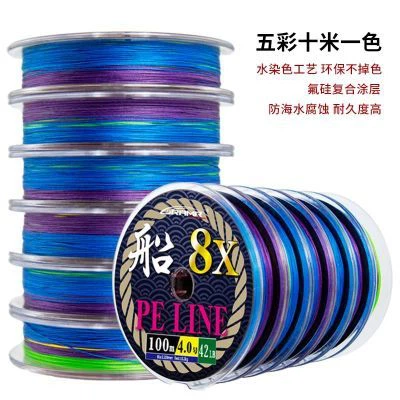
PE line (polyethylene braided line): PE line has a very high tensile value, but has almost no ductility, is easy to break, and is not as wear-resistant as other materials. It is often used as the main line for lure fishing, especially when challenging large fish.
Ceramic line: This line has strong tensile strength, low extensibility, excellent texture, wear resistance and tensile resistance, but the price is relatively high. Its surface protective film has no pores, is corrosion-resistant, and has stable quality.
Nylon line: Made of multiple strands of nylon fiber, it is opaque, has strong tensile strength, and good wear resistance, but it is easy to harden and become brittle, and is suitable for weaving nets and ground rod fishing.
Memory ceramic line: Based on the ceramic line, the memory restoration function is added, which is suitable for suspended fishing line, with high wear resistance and sensitivity.
Floating line: The density is close to water, the light weight can reflect the signal of fish eating bait, and it is suitable for competitive fishing of small fish or fast fish.
Beckert fire line: It is composed of multiple fine fibers, has strong tensile strength, does not absorb water, and is less affected by water flow. It is mainly used for trolling large marine fish at sea.
Variable diameter line: This line has a small diameter at one end and a large diameter in the middle. It is mainly used for casting fishing and can effectively expand the capacity of the fishing reel.
Fly fishing line: This line is hollow and has different diameters. It is mainly used for fly fishing, which is conducive to slowing down the speed of the bait hook and increasing the frequency of fish biting the hook.
Fishing lines made of these materials each have their own unique characteristics and applicable scenarios. Choosing the right fishing line is crucial to fishing success.